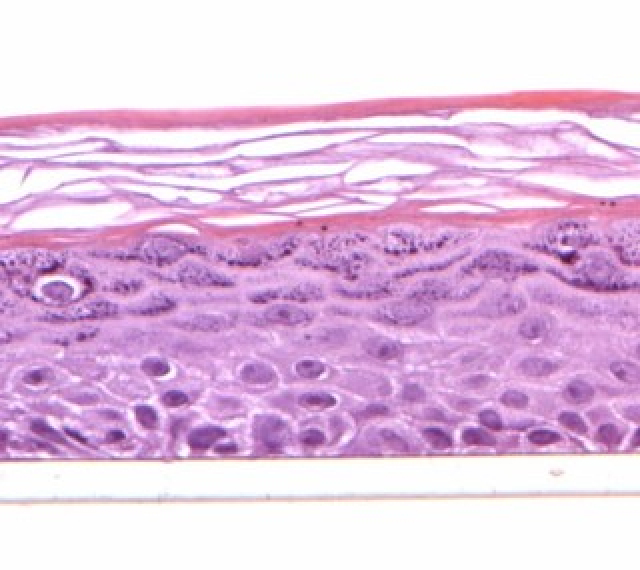
Since its beginning as Europe’s first skin model for product testing, our Leiden Epidermal Model has led the industry for over 30 years. Get fast, reliable results for testing your cosmetic, pharmaceutical, or chemical product.
Quick facts:
Fully stratified epidermis
Primary human keratinocytes
EURL-ECVAM pre-validated
Animal origin-free
Applications
Toxicology: Skin corrosion and irritation
Dosage testing
Phototoxicity
Penetration
Model variants
Eczema, psoriasis
Microbiome inoculated
Pigmented (skin types 4-6)
Wounding
Specifications
6-well, 12-well, or 24-well formats available
4 week culture longevity
Request a quote
Contact us to request a quote or find out more about our Leiden Epidermal Models
We engineer fully stratified human epidermis using primary human keratinocytes
These models are ideal for testing a broad range of ingredients in cosmetic, cosmeceutical, pharmaceutical, chemical, and everyday products.
Clients can choose to receive the skin models directly for in-house testing or take advantage of our in-house testing services for comprehensive analysis
APPLICATIONS
The Leiden Epidermal Model can be used for a number of product tests, including:
Toxicology: Skin irritation and corrosion testing is performed in line with OECD Guidelines, specifically Test No. 431, allowing for accurate assessment of compounds for safety and regulatory compliance.
Dosage optimization: Send us your compound of interest, and we will determine the optimal concentration for safety and efficacy by assessing cell viability, response markers, and target engagement.
Phototoxicity: Using UV exposure tests, following OECD Test Guideline No. 498, we evaluate how your product affects skin sensitivity to light, providing insights into potential phototoxic effects.
Penetration: Our testing methods analyze how deeply your product penetrate into the epidermis and/or dermis, particularly useful for evaluating transdermal delivery systems and topical efficacy.
Case study
Our client, looking to bring a novel cosmetic compound to the market, required a data dossier for safety testing of two compounds, proving their optimal concentration.
We tested multiple concentrations of the active compound on our standard Leiden Epidermal Model, and assessed the following skin corrosion readouts:
Cell viability
Morphology
Interleukin 1α
The final report, complete with the dataset, was sufficient for our client to continue their experimentation in further phases of the study.